Polish Press Agency
Another Day of LifeThe Polish Press Agency (PAP) is the news organization that employed Ryszard Kapuściński as a foreign correspondent and connected his reporting from Angola to Warsaw. In Another Day of Life, the agency is more than a line in his professional biography: its nightly telex exchanges establish a recurring point of contact in a city where communications, public services, and ordinary routines are breaking down. The contrast between brief dispatches and the book’s extended eyewitness scenes also makes visible the distance between sending news and living through the events it describes.
Identity and Correspondent Work
The book identifies Kapuściński as a PAP correspondent. The author biography describes him as a foreign correspondent for the agency until 1981, reporting on revolutions and civil wars in Africa, Asia, and Latin America. The Angola assignment arose in the summer of 1975, after his editor presented it as his last chance to reach the country. The war was already under way, and the prospect of Angola becoming isolated from outside help formed part of the danger surrounding the assignment.
PAP appears in the narrative principally through its working relationship with its correspondent rather than through descriptions of its offices, staff, or editorial policies. The book gives no detailed account of how the agency selected, edited, or distributed his reports. What it does show is the practical arrangement from Luanda: a correspondent observes a fast-changing conflict, prepares dispatches, and sends them through a hotel telex connection to the Warsaw desk.
The Nightly Link with Warsaw
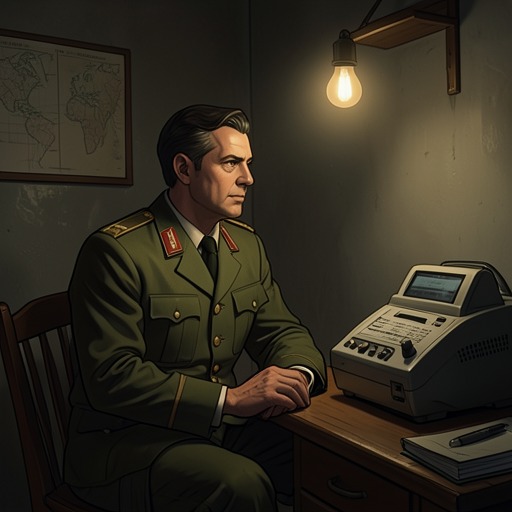
At nine each evening, the telex machine at the hotel reception desk lit up as Warsaw called. The machine printed a signal asking for material; Kapuściński replied and played a tape containing the text of his dispatch. The exchange recurred daily, and he sometimes went to the telex well before the appointed hour, waiting for its lights to come on. At the end of the contact, Warsaw signed off with the time of the next communication, turning the next day’s report into part of an established routine.
That routine mattered to the correspondent personally as well as professionally. He describes writing even the briefest dispatch as a way of overcoming inertia and depression and maintaining contact with Warsaw. The evening exchange relieved his sense of loneliness and abandonment. He tried to prolong the conversations by describing battles, asking about the weather at home, and mentioning his lack of food. The agency connection therefore carried two kinds of traffic: news from the war zone and a recurring human contact with a distant workplace.
The same connection could become difficult to sustain when events interrupted the schedule. During a critical moment in Luanda, Kapuściński began answering the telex but paused when the MPLA chief of staff announced a general mobilization over the radio. He listened to the announcement before continuing to type a last-minute dispatch. The sequence places the correspondent between two immediate demands: the agency’s request for a report and a broadcast announcing that the city faced a grave military situation.
Reporting amid Uncertainty
The reports were produced in an information environment crowded with claims that could not be treated as equivalent. In September, leaflets dropped over Luanda announced that Holden Roberto’s army was outside the capital and urged the population to kill supposed foreign commanders of the MPLA. The city was also filled with rumors of an imminent uprising, while the absence of authority and the presence of hostile groups made the threats difficult for residents to assess. These details form part of the circumstances in which PAP’s correspondent was working; the book does not establish that each was included in a dispatch.
Other information came through the MPLA’s public communications. Comandante Ju-Ju read military communiqués over the radio each evening. Kapuściński notes that their tone changed with the reported fortunes of the fighting: accounts were brief when things were going well, but grew longer and more emphatic when the situation worsened. From Luanda, the length of the broadcast itself became an indirect clue to conditions at the front, even when its words could not be made out from the street. Later, while half the country was in enemy hands, the communiqués still presented the MPLA as close to victory. The book sets that optimism against the danger the correspondent observed, showing why the source and framing of wartime information mattered.
The city’s material decline supplied another part of the reporting context. In early October, water grew scarce because pumping stations on the front lines were repeatedly destroyed after repairs. Shops and restaurants closed, and the streets became increasingly empty. The fire brigade had also deserted its station, leaving its engines, ladders, hoses, and helmets behind; a pump vehicle later used to carry water toward the front was hit and left in a ditch. These failures were not simply background to the fighting: they shaped civilian life and the conditions under which news from Luanda could be gathered and transmitted.
Dispatches and the Book’s Form
The narrative preserves fragments of the agency’s communication alongside the scenes surrounding them. The telex signals, replies, and beginnings of dispatches give the reader glimpses of the wire-service exchange, while the surrounding prose supplies circumstances that a short transmission could not encompass. When artillery shook Luanda and Holden Roberto announced an intended entry into the city, the narrative describes the immediate alarm and the possibility that the attackers might reach the capital. Elsewhere, after Kapuściński returned from the southern front in an airplane carrying wounded local and Cuban soldiers, the book records the opening of the message sent to Warsaw about the front’s new position along the Cuvo River.
A dispatch also marked the day of Angolan independence. On 11 November, after Agostinho Neto proclaimed the People’s Republic of Angola, Kapuściński sent Warsaw a report on the celebrations in Luanda. By placing this brief transmission next to the quiet square, the fading lights, the soldiers’ celebratory gunfire, and the exhausted hotel residents, the book contrasts the compressed announcement of a national turning point with the unsettled scene in which it occurred.
The Polish Press Agency thus anchors the book’s account of correspondence without becoming its narrative subject in the institutional sense. Its recurring telex contact gives Kapuściński a structure for reporting and a means of resisting isolation; the dispatch fragments, set against personal observation and broadcast claims, also reveal the limits of what a short report can carry. PAP’s presence is clearest at the point where the correspondent must turn immediate, uncertain experience into news for Warsaw.